


Google's €4.1 Billion Android Antitrust Fine Upheld

For nearly a decade, Google's battle with European regulators has stood at the centre of the global debate on Big Tech's market power. That battle has now reached its conclusion.
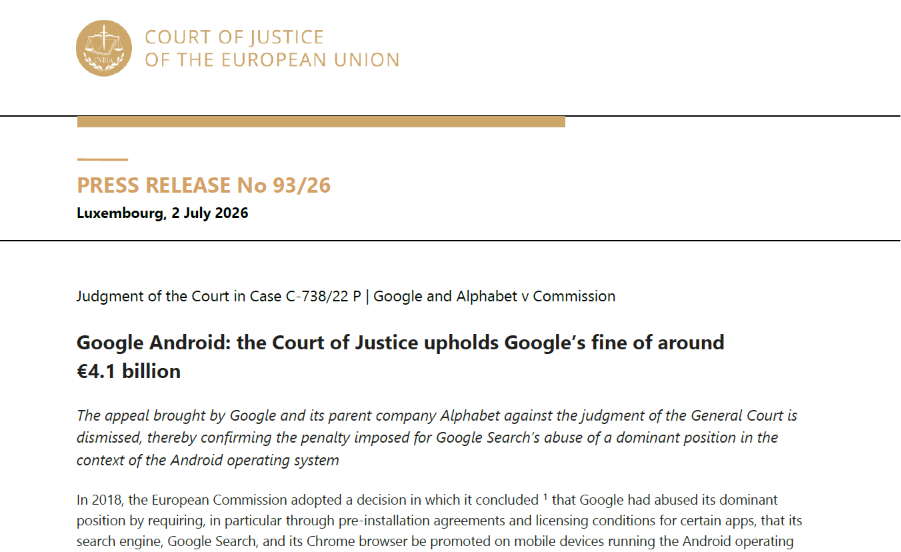
The European Union's highest court has dismissed Google's final appeal, confirming a record €4.1 billion antitrust fine for abusing the dominance of its Android mobile operating system.
The judgment not only closes one of the largest competition cases in history but also reinforces the principle that technological innovation cannot come at the cost of fair market competition.
What's The Matter?
The case arose from the European Commission's 2018 decision, which found that Google had imposed restrictive contractual conditions on smartphone manufacturers and mobile network operators.
To obtain access to the Google Play Store an essential gateway for Android devices manufacturers were required to pre-install Google Search and the Chrome browser.
In addition, Google was found to have provided financial incentives to manufacturers and network operators to exclusively pre-install Google Search, while also preventing the sale of devices running alternative versions (or "forks") of Android that were not approved by Google.
What Commission Said?
According to the Commission, these practices effectively ensured that Google's own services remained the default choice for billions of users, making it exceedingly difficult for rival search engines and browsers to compete.
Rather than allowing competition on the merits, Google's contractual ecosystem was held to have leveraged Android's market dominance to strengthen its position in online search.
Google challenged the decision before the EU courts. While the General Court slightly reduced the penalty from €4.34 billion to €4.125 billion, it substantially upheld the Commission's findings that Google had abused its dominant position. Google subsequently pursued a final appeal before the Court of Justice of the European Union (CJEU), arguing that the lower court had committed legal errors in its assessment.
The CJEU has now rejected those arguments, bringing the litigation to an end. With the appeal dismissed, the reduced €4.1 billion fine becomes final, confirming that Google's Android licensing practices violated EU competition law.
the case underscores that competition law is about preserving meaningful choice. Default settings and mandatory pre-installation agreements may appear commercially convenient, but when they effectively eliminate opportunities for rivals, they can distort competition for years.
The court's decision signals that digital platforms enjoying dominant market positions carry special responsibilities under competition law.
Together with the EU's recent Digital Markets Act, the decision sends a clear message that market dominance does not provide immunity from legal scrutiny.
Google remains one of the world's most innovative technology companies, but the judgment serves as a reminder that innovation must coexist with competitive fairness.
In the digital economy, protecting open markets is ultimately about ensuring that consumers—not contractual restrictions determine which products succeed.
Case: Google LLC v. European Commission (Android Antitrust Case)
Court: Court of Justice of the European Union (CJEU)
Issue: Abuse of dominant position through Android licensing and pre-installation agreements under EU competition law.


Comments