


No Equal Penalty Rule in Disciplinary Matters: Rank Matters, Harsher Action Against Senior Bank Officer

The Supreme Court’s decision in this case offers a sharp reaffirmation of the limits of judicial review in disciplinary matters, particularly when the plea of parity is invoked under Article 14 of the Constitution.
equality does not mean uniformity when responsibility and rank differ.
At the heart of the dispute was the respondent, a Senior Manager, who was dismissed from service following disciplinary proceedings that found him guilty of misappropriation and misconduct in connivance with two co-delinquents.
While the co-delinquents a lower-ranking officer and a gunman received comparatively lenient punishments, the respondent was awarded the extreme penalty of dismissal.
The Delhi High Court intervened, invoking Article 14, and modified the punishment to compulsory retirement on the ground of discriminatory treatment.
The Supreme Court, however, decisively overturned this reasoning. It held that the High Court had misapplied the doctrine of equality by mechanically comparing punishments without appreciating the qualitative differences in roles, responsibilities, and the degree of trust reposed in the delinquent employees.
The Court emphasized that higher rank entails higher accountability.
A Senior Manager, entrusted with supervisory and fiduciary responsibilities, cannot be equated with subordinate staff for the purpose of determining proportional punishment.

Thus, the differentiation in penalties was not arbitrary but rooted in rational classification.
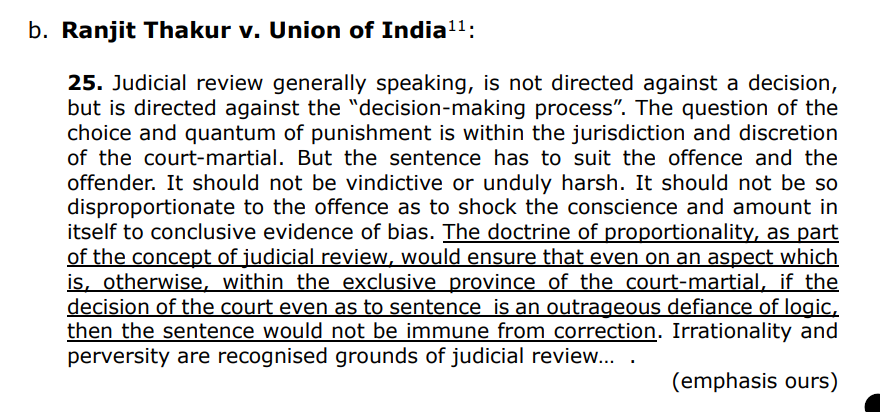
In doing so, the Court revisited and consolidated its jurisprudence on proportionality and judicial restraint. Relying on precedents such as Ranjit Thakur v. Union of India and B.C. Chaturvedi v. Union of India, the judgment reiterates that judicial review is concerned not with the decision per se but with the decision-making process.
Interference with punishment is warranted only when it is “shockingly disproportionate” or in “outrageous defiance of logic.”
The metaphor employed by the Court “using a sledgehammer to crack a nut” captures the threshold succinctly. Absent such extremity, courts must defer to the disciplinary authority’s discretion.
Significantly, the Court rejected the High Court’s reliance on parity with co-delinquents as a standalone ground for interference.
It clarified that Article 14 does not mandate identical outcomes in disciplinary proceedings, especially where the nature of duties and levels of responsibility differ.
The principle of parity, though relevant, cannot override contextual factors such as hierarchy, trust, and the gravity of breach in relation to the position held.
By restoring the penalty of dismissal, the Court signaled that misconduct by those in positions of trust warrants stricter scrutiny and proportionately severe consequences.

In conclusion, case reinforces a calibrated balance between equality and proportionality.
It cautions against an over-expansive reading of Article 14 in service jurisprudence and reaffirms that judicial review is not an appellate forum on punishment.
The judgment stands as a precedent that parity cannot be claimed in abstraction; it must be grounded in comparable circumstances, failing which differentiation is not discrimination but a reflection of accountability

Disclaimer: This content is published strictly for educational and informational purposes only. It does not constitute legal advice, nor should it be relied upon as a substitute for professional legal counsel.
--------------------------------------------------------------------------------------------------------------------------------------------------------
Case Details:
PUNJAB AND SIND BANK VS. RAJ KUMAR - C.A. No. 847/2026 - Diary Number 53027 / 2024
--------------------------------------------------------------------------------------------------------------------------------------------------------


Comments